
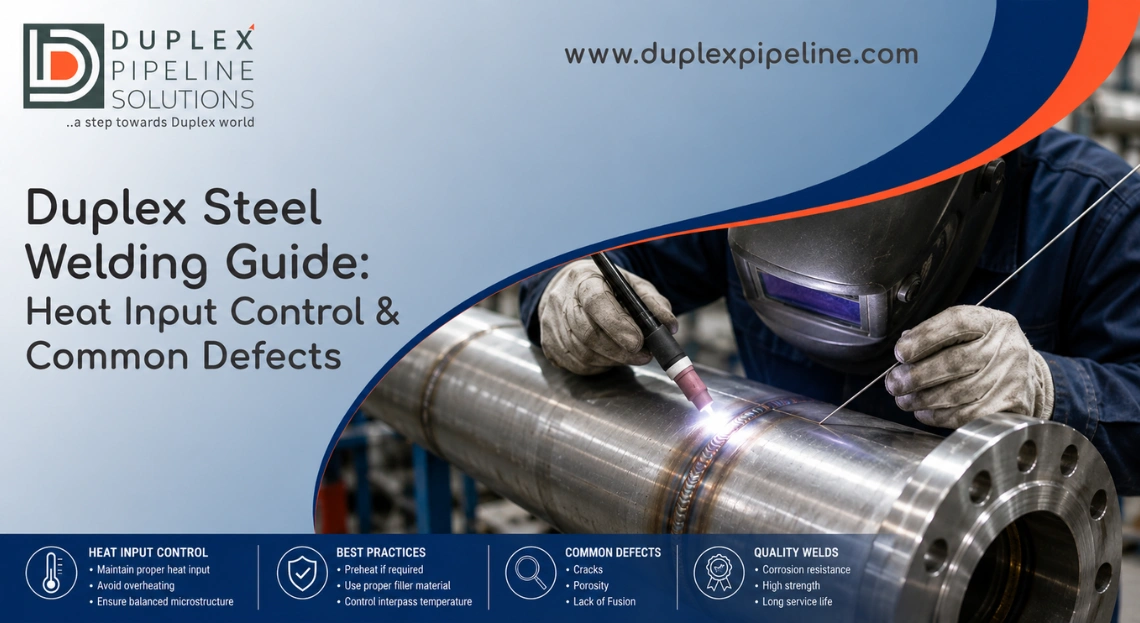
Duplex Steel Welding Guide: Heat Input Control & Common Defects
Duplex Steel Welding Guide: Heat Input Control & Common Defects
Duplex stainless steel earns its reputation from a carefully balanced microstructure roughly equal parts austenite and ferrite. That balance is exactly what makes welding duplex material harder than welding standard austenitic grades. Get the heat input wrong, and the phase balance shifts, corrosion resistance drops, and a weld that looked fine on the surface can fail years later in service. For fabricators working on steel pipe, flanges, or heat exchanger assemblies for marine engineering and offshore projects, understanding heat input control isn’t optional it’s the difference between a joint that lasts and one that doesn’t.
This guide covers what happens metallurgically when duplex steel pipe, stainless steel pipe fittings, and flange assemblies are welded, how to control heat input properly, and the defects buyers and fabricators should watch for during inspection.
Why Duplex Welding Is Different
Standard austenitic stainless steel pipe is comparatively forgiving to weld its single-phase structure doesn’t shift dramatically with heat exposure. Duplex steel behaves differently. The weld metal and heat-affected zone go through a phase transformation as they cool, and how much austenite reforms depends heavily on cooling rate, which is itself controlled by heat input. A fabricator experienced only with stainless steel pipe welding can be caught off guard by how quickly duplex material moves outside its acceptable phase balance.
Too little heat input, and the weld cools too fast for enough austenite to form, leaving an excessively ferritic structure that’s brittle and more prone to cracking. Too much heat input, and the material spends too long at high temperature, allowing harmful intermetallic phases to form and reducing toughness and corrosion resistance. Getting duplex steel pipe, flanges, and fasteners welded correctly means staying inside a fairly narrow process window on every pass.
Heat Input Control: The Core of a Good Duplex Weld
Calculating and Monitoring Heat Input
Heat input is generally calculated from welding current, voltage, and travel speed, and most duplex welding procedures specify a target range in kJ/mm rather than leaving it to operator judgment. Fabricators working on critical stainless steel pipe or flange welds should log heat input for every pass, not just spot-check it, since a single overheated pass can compromise an otherwise well-executed joint.
Interpass Temperature
Alongside heat input, interpass temperature needs tight control. Most duplex welding procedures cap interpass temperature well below what’s acceptable for standard stainless, because excessive heat buildup across multiple passes has the same damaging effect as a single high heat-input pass. This matters especially on thicker steel pipe and heavy steel flanges where multiple passes are unavoidable.
Filler Metal Selection
Duplex filler metals are typically over-alloyed with nickel compared to the base metal, which helps promote austenite formation in the weld metal during cooling. Using the correct filler metal, matched to the specific duplex or super duplex grade of the steel pipe or flange being joined, is just as important as controlling heat input itself.
Common Defects in Duplex Steel Welds
Excessive Ferrite Content
The most frequent issue in duplex welding is a weld or heat-affected zone that ends up too ferritic. This typically results from heat input that’s too low or cooling that’s too fast, and it reduces both toughness and corrosion resistance. Ferrite content is checked with a calibrated ferritescope or by metallographic examination, and most specifications require the finished weld to fall within a 30-70% ferrite range.
Secondary Austenite and Nitride Precipitation
At the other extreme, excessive heat input or slow cooling can allow secondary austenite and chromium nitrides to precipitate, which locally depletes chromium and nitrogen from the surrounding matrix and creates sites vulnerable to pitting corrosion. This defect is particularly dangerous because it’s not always visible without detailed metallurgical testing, yet it directly undermines the corrosion resistance the duplex grade was specified for in the first place.
Sigma Phase Formation
Prolonged exposure in the 600-1000°C range whether from excessive heat input, poor interpass control, or improper post-weld heat treatment can trigger sigma phase formation. Sigma phase is hard and brittle, and its presence significantly reduces impact toughness, which is a serious concern for any structural steel pipework or steel flanges expected to perform in cold offshore conditions.
Porosity and Nitrogen Loss
Nitrogen is a key alloying element in duplex grades, and it can be lost from the weld pool during welding, particularly with processes that don’t adequately shield the molten metal. Nitrogen loss shifts the phase balance toward excess ferrite and can also contribute to porosity. Proper shielding gas selection, often nitrogen-enriched for GTAW root passes, helps counteract this.
Welding Considerations by Component
Steel Pipe and Piping Systems
Girth welds joining sections of steel pipe carry the highest scrutiny, since they see full-pressure service and are typically the hardest joints to access for repair once installed, especially in subsea or marine engineering applications. Root pass quality on steel pipe welds is critical, and back-purging with an appropriate shielding gas is standard practice to protect the root from oxidation and nitrogen loss. The same discipline applies to ss tube runs feeding process or cooling equipment, where a compromised root pass is just as costly to repair after installation.
Steel Flanges
Welding steel flanges to pipe introduces a thicker section and a geometry change, both of which affect local heat input and cooling rate compared to a straight pipe-to-pipe joint. Fabricators need to adjust welding parameters accordingly rather than applying the same procedure used for the connecting steel pipe, and post-weld inspection at the flange hub is worth extra attention given the higher stress concentration at that joint.
Fasteners and Bolted Connections
Fasteners themselves are generally not welded bolts, studs, and nuts are manufactured from round bar and installed as bolted connections rather than welded joints. However, when duplex fasteners are used to secure a welded flange assembly on a marine engineering project, it’s worth confirming the fastener grade matches the base metal to avoid galvanic issues at the joint, since a well-executed weld can still be undermined by a mismatched bolted connection nearby.
Heat Exchanger Tube-to-Tubesheet Welds
Heat exchanger fabrication presents its own welding challenge: tube-to-tubesheet joints in duplex ss tube assemblies are typically thin-walled and welded with tight heat input control to avoid distortion and to preserve the corrosion resistance of both the tube and tubesheet material. Because these tubes often can’t be replaced individually once the unit is in service, welding quality here has an outsized effect on the equipment’s lifespan.
Inspection and Quality Control
A properly welded duplex joint should be verified, not assumed. This applies equally to steel flanges, ss tube assemblies, and pipe girth welds. Standard practice includes:
- Visual inspection for surface defects and discoloration, which can indicate inadequate shielding gas coverage
- Ferrite content measurement at multiple points along the weld
- Radiographic or ultrasonic testing for internal defects like porosity or lack of fusion
- Corrosion testing, such as ASTM G48, for critical steel pipe, flange, or heat exchanger welds in high-chloride service
- Impact testing when the application requires confirmed toughness at low temperature
Final Thoughts
Welding duplex steel isn’t fundamentally different in technique from welding other stainless grades, but the tolerance for error is much smaller. Heat input control, interpass temperature, and correct filler metal selection all work together to preserve the phase balance that gives duplex steel pipe, flanges, and fasteners their corrosion resistance in the first place. Getting it wrong doesn’t always show up immediately — it shows up years later, in the field, when it’s far more expensive to fix.
At Duplex Pipeline, we supply duplex and super duplex steel pipe, flanges, fasteners, ss tube, and heat exchanger components for marine engineering and offshore fabrication. If your project needs material backed by proper mill certification and welding-grade documentation, reach out for current availability.