
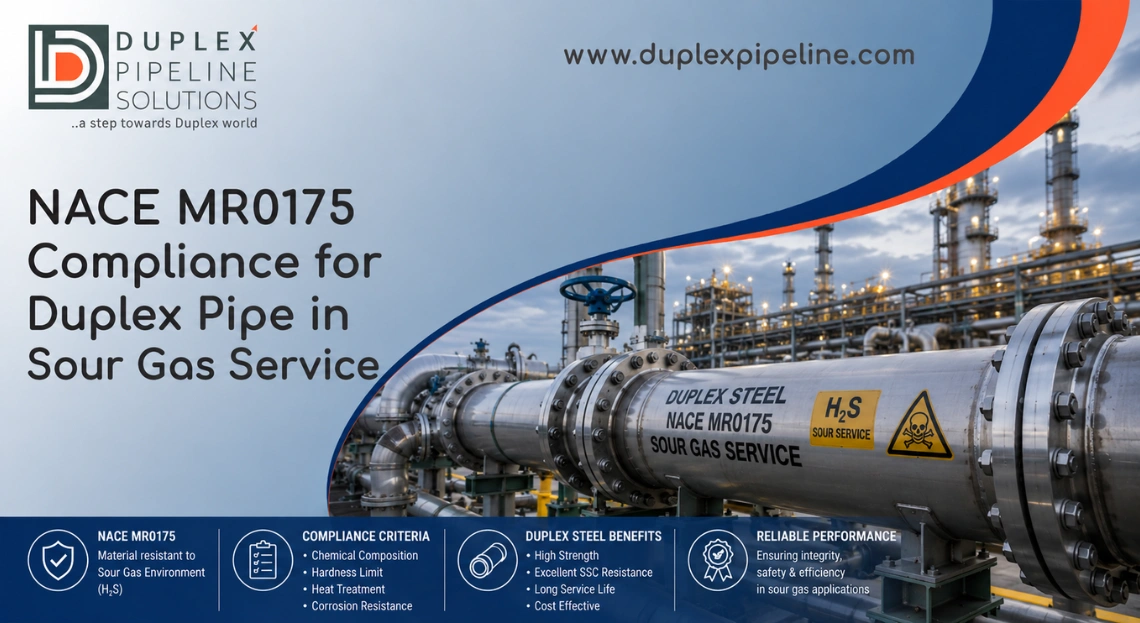
NACE MR0175 Compliance for Duplex Pipe in Sour Gas Service
NACE MR0175 Compliance for Duplex Pipe in Sour Gas Service
Sour gas service is one of the least forgiving environments a piping system can be asked to handle. Hydrogen sulfide doesn’t just corrode metal the way seawater does it can crack it from the inside, often with little warning, through a mechanism called sulfide stress cracking. That’s why NACE MR0175, now published jointly with ISO as ISO 15156, exists as the governing standard for material selection in H2S-containing oil and gas environments. For buyers specifying duplex steel pipe, flanges, and fasteners for sour service, understanding what this standard actually requires is the difference between a compliant, reliable system and an expensive field failure.
This guide covers what NACE MR0175 compliance means in practice, why duplex grades are treated differently than standard stainless, and what to check before ordering material for a sour gas project.
What Is NACE MR0175 and Why It Matters
NACE MR0175 sets out material requirements for equipment used in H2S-containing environments across oil and gas production, and it’s now aligned internationally with ISO 15156. The standard exists because hydrogen sulfide, in the presence of moisture and mechanical stress, can cause sulfide stress cracking in susceptible metals a brittle failure mode that can occur well below a material’s normal yield strength and without obvious warning signs beforehand.
Because sulfide stress cracking depends heavily on hardness, microstructure, and stress level, NACE MR0175 doesn’t simply ban certain alloys. Instead, it defines conditions under which specific material classes, including duplex and super duplex grades, are acceptable covering hardness limits, heat treatment condition, and environmental severity limits based on H2S partial pressure, chloride concentration, temperature, and pH.
Why Duplex Steel Pipe Is Frequently Specified for Sour Service
Duplex stainless steel pipe has become a common choice in sour gas applications because its two-phase microstructure offers a strong combination of mechanical strength and resistance to both chloride-induced and sulfide-induced cracking, provided the material is properly processed and controlled to meet the standard’s requirements. The same logic applies to the steel flanges and matching stainless steel pipe fittings that connect a sour service line corrosion resistance in the run of pipe means little if the connection hardware wasn’t specified to the same grade.
That said, duplex isn’t automatically compliant just because it’s duplex. NACE MR0175 imposes specific hardness limits on duplex steel pipe, steel flanges, and bolted connections intended for sour service, and it restricts how the material can be processed cold work, for example, increases hardness and can push a component outside the acceptable range even if the base alloy would otherwise qualify.
Key Requirements Buyers Need to Understand
Hardness Limits
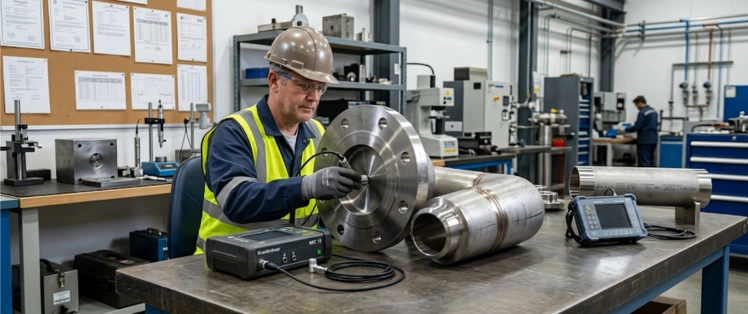
Hardness is the single most scrutinized property under NACE MR0175 for duplex materials. Steel pipe, steel flanges, and fasteners must be tested and documented to confirm hardness falls within the limits specified for the applicable duplex grade, typically measured on the Rockwell C or Vickers scale depending on the component geometry. Bolting is particularly prone to hardness issues because the manufacturing process cold heading or machining from bar stock can locally work-harden the material if not properly controlled.
PREN and Environmental Severity Limits
The Pitting Resistance Equivalent Number, or PREN, is used alongside hardness to assess a duplex grade’s suitability for a given sour environment. Higher PREN values generally correlate with better resistance to localized corrosion, and NACE MR0175 references environmental severity H2S partial pressure, chloride level, temperature, and pH to determine which duplex or super duplex grade is appropriate for a specific well or process condition. A grade acceptable for moderate sour service may not be acceptable for a high-H2S, high-chloride well without upgrading to a higher-alloy super duplex.
Heat Treatment and Microstructure Control
NACE MR0175 requires duplex material, including stainless steel pipe and flange components, to be properly solution-annealed and quenched to achieve the correct phase balance and avoid harmful intermetallic phases. Improper heat treatment, or field welding that isn’t followed by appropriate post-weld heat treatment where required, can push otherwise compliant steel pipe or flange material outside acceptable limits without any visible sign of the problem.
Steel Flanges and Fasteners: Where Sour Service Compliance Gets Complicated
Piping itself tends to receive the most attention during specification, but steel flanges and fasteners deserve equal scrutiny in sour gas projects. Flanges are typically forged rather than rolled, and the forging process, combined with subsequent heat treatment, has a direct effect on final hardness and therefore NACE MR0175 compliance. A flange that meets the chemistry requirements for a duplex grade can still fail hardness testing if the forging or heat treatment wasn’t controlled correctly.
Bolted hardware carries its own risks. Bolts and studs machined from duplex round bar need documented hardness testing on the finished part, not just the raw material, since cold working during thread rolling or heading can locally increase hardness beyond acceptable limits. Buyers should never assume that because a supplier’s raw bar stock was NACE-compliant, the finished bolting automatically is — testing at the finished-part stage is what the standard actually requires. Specifying matching, NACE-compliant steel flanges and fasteners alongside the connecting stainless steel pipe closes a gap that’s easy to overlook if procurement treats piping and connection hardware as separate line items.
Sour Service Considerations Beyond the Main Pipeline
Marine Engineering and Offshore Sour Gas Projects
Offshore sour gas developments add an extra layer of complexity, since marine engineering teams have to account for both H2S exposure and chloride-rich seawater simultaneously. In these projects, duplex or super duplex grades often need to satisfy NACE MR0175 hardness and environmental severity limits while also delivering the corrosion resistance expected of marine engineering applications more broadly, which is why offshore sour service specifications frequently call for higher-alloy grades than an equivalent onshore project would require.
SS Tube and Instrumentation Lines
Sour gas facilities rely on extensive networks of small-bore ss tube for instrumentation, sampling, and control systems, and these lines see the same H2S exposure as the main process piping. NACE MR0175 compliance applies to ss tube fittings and small-bore connections just as much as it does to the primary steel pipe, and it’s a common gap in sour service projects where instrumentation hardware doesn’t receive the same certification scrutiny as the main line.
Heat Exchanger Components in Sour Service
Heat exchanger units processing sour gas or associated liquids need tube, tubesheet, and flange material that meets the same NACE MR0175 requirements as the connected piping. Because heat exchanger tube bundles are difficult and expensive to replace, verifying hardness and heat treatment compliance before installation matters even more here than on a straightforward run of steel pipe.
A Buyer’s Checklist for NACE MR0175 Compliant Material
- Confirm the exact H2S partial pressure, chloride concentration, temperature, and pH for your service conditions, since these determine which duplex or super duplex grade is actually acceptable.
- Request documented hardness test results for finished steel pipe, flanges, and fasteners — not just certificates for the raw material.
- Verify heat treatment records confirming proper solution annealing for all duplex components.
- Ensure ss tube, instrumentation fittings, and heat exchanger components carry the same NACE compliance documentation as the main process piping.
- Ask suppliers for current mill test certificates referencing NACE MR0175 or ISO 15156 explicitly, not a generic compliance statement.
- For offshore or marine engineering projects, confirm the specified grade accounts for combined H2S and chloride exposure, not just one or the other.
Final Thoughts
NACE MR0175 compliance isn’t a box to check once at the material order stage it depends on chemistry, hardness, heat treatment, and even how a component was machined or formed. Duplex steel pipe, flanges, and fasteners can absolutely meet the standard’s requirements for sour gas service, but only when every step of processing is controlled and documented. Cutting corners on testing at the finished-part level is one of the most common and costly mistakes buyers make in sour service procurement.
At Duplex Pipeline, we supply NACE MR0175 compliant duplex and super duplex steel pipe, flanges, fasteners, ss tube, and heat exchanger components for sour gas and marine engineering projects. Reach out for mill certification details and current stock for your sour service requirements.