
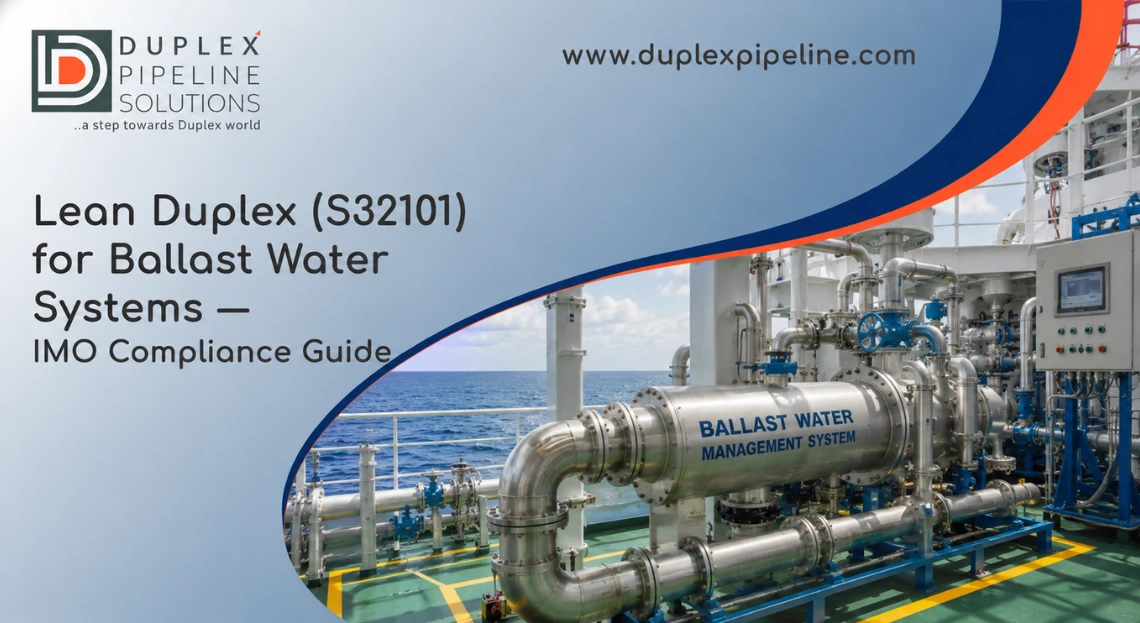
Lean Duplex (S32101) for Ballast Water Systems IMO Compliance Guide
Lean Duplex (S32101) for Ballast Water Systems IMO Compliance Guide
Ballast water treatment has quietly become one of the most demanding corrosion challenges in modern marine engineering. Every commercial vessel now needs a system that can disinfect and discharge ballast water without violating international rules, and that system has to survive years of exposure to seawater, chemicals, and UV treatment byproducts without breaking down. This is exactly why lean duplex grade S32101 has become the material of choice for the steel flanges, fasteners, and pipework that make up a compliant ballast water treatment skid. Duplex Pipeline Solutions supplies lean duplex steel products for demanding marine applications, helping buyers select corrosion-resistant materials for ballast water treatment systems.
If you’re specifying or purchasing components for a ballast water system, this guide walks through what lean duplex S32101 actually offers, how it fits into IMO compliance requirements, and what to check before ordering flanges, bolting, or supporting pipe.
Why IMO Compliance Changed Material Selection for Ballast Water Systems
The IMO’s Ballast Water Management Convention, which entered into force in 2017, requires ships to treat ballast water to meet strict D-1 and D-2 discharge standards before it can be released. Treatment systems typically rely on filtration combined with UV disinfection or electrochlorination, both of which create an aggressive internal environment. Electrochlorination in particular produces chlorine byproducts that attack standard 316 stainless steel pipe far faster than most engineers expect.
Shipbuilders and system integrators quickly learned that ordinary austenitic stainless wasn’t durable enough for long-term IMO compliance, which pushed marine engineering teams toward lean duplex alternatives that could handle chloride exposure without the weight or cost penalty of super duplex grades.
What Makes Lean Duplex S32101 a Good Fit
Lean duplex S32101 sits between standard 304/316 stainless and the more expensive super duplex family. It offers a two-phase microstructure of austenite and ferrite, giving it meaningfully higher strength and better resistance to pitting and stress corrosion cracking than conventional stainless steel pipe, at a lower nickel content and therefore lower cost.
For ballast water systems, that combination matters for three reasons:
Chloride and Byproduct Resistance
- It resists the chlorides and treatment byproducts found in electrochlorination systems better than standard austenitic grades.
- Its higher strength allows thinner-walled piping and ss tube runs, reducing overall system weight, which matters on tightly packed engine room layouts.
- It’s more cost-effective than super duplex, making it practical for the large volume of piping, flanges, and bolted hardware a full ballast water skid requires.
Steel Flanges and Fasteners: The Overlooked Weak Points
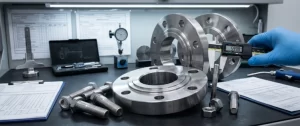
Piping specifications tend to get the most attention, but flange joints and bolted connections are often where corrosion problems actually start. A flange sees more mechanical stress, more crevice exposure, and more risk of galvanic mismatch than a straight run of pipe, especially in a system that’s wet, warm, and chemically active around the clock.
When specifying steel flanges for a ballast water treatment skid, they should be manufactured from the same lean duplex grade as the connecting steel pipe wherever possible. Mixing a standard stainless flange with a duplex pipe run creates a chemistry mismatch that can trigger galvanic corrosion at exactly the point where a leak would be most disruptive.
Bolted hardware deserves the same scrutiny. Bolts, nuts, and studs used to secure flange joints and equipment brackets are frequently overlooked and sourced as a generic commercial item, even though they sit directly in the corrosive environment. Bolting specified in a matching duplex or a compatible high-alloy grade lasts significantly longer than standard A2 or A4 stainless hardware in ballast water service, and replacing corroded fasteners on a working vessel is far more disruptive than specifying the right grade up front.
Where Lean Duplex Shows Up Across the System
A typical ballast water treatment package includes more than just the main flow line. Lean duplex S32101 is increasingly specified across:
Key Components That Use Lean Duplex
- Main treatment loop piping and ss tube runs carrying seawater through the filter and UV or electrochlorination units
- Flange connections joining the filter housing, UV chamber, and control valves
- Bolting that secures the skid frame, flange joints, and instrumentation brackets
- Heat exchanger shells and tube sheets, where seawater cooling circuits are exposed to the same chloride-rich conditions as the main treatment line
- Sample points and bypass piping, which see intermittent flow and are prone to crevice corrosion if the wrong grade is used
Heat exchanger components in particular benefit from lean duplex because cooling circuits often run at higher temperatures than the main treatment line, which accelerates corrosion in lower-grade stainless steel pipe. Specifying duplex tube and flange material for the heat exchanger interface reduces the risk of an early failure in a component that’s difficult and expensive to replace once installed.
Lean Duplex vs Standard Stainless Steel Pipe: A Quick Comparison
Buyers comparing lean duplex against conventional 316 stainless steel pipe should weigh a few practical differences:
Corrosion Resistance, Strength, Cost, and Weldability
- Corrosion resistance: Lean duplex outperforms 316 in chloride-rich, electrochlorination-treated water, which is the environment most ballast systems actually operate in.
- Strength and weight: Higher yield strength allows thinner-walled tube and flange sections for the same pressure rating, trimming weight from the overall skid.
- Cost: Lean duplex carries a premium over 316 but remains considerably cheaper than super duplex, making it the practical middle ground for most ballast water applications.
- Weldability: Lean duplex welds similarly to standard duplex grades but requires correctly qualified procedures — this is worth confirming with your fabricator before ordering large volumes of pipe, flanges, or hardware.
A Buyer’s Checklist Before Ordering
Before finalizing an order for a ballast water treatment system, it helps to run through the following:
- Confirm the exact IMO discharge standard (D-1 or D-2) your system must meet, since this affects the treatment method and therefore the corrosion environment.
- Specify lean duplex S32101 (or equivalent) for main piping, ss tube, steel flanges, and fasteners in direct contact with treated seawater.
- Request mill test certificates confirming chemistry and mechanical properties for every batch of material.
- Match flange, bolting, and pipe grades to avoid galvanic mismatch at joints.
- Ask your supplier whether heat exchanger components are rated for the same chloride exposure as the main treatment loop.
- Get quotes from more than one marine engineering supplier, since duplex material pricing can shift with nickel and molybdenum market movements.
Final Thoughts
Ballast water treatment systems are unforgiving of shortcuts. A compliant system that fails early because of the wrong flange or fastener grade defeats the purpose of investing in IMO-compliant equipment in the first place. Lean duplex S32101 has earned its place as the practical standard for marine engineering teams because it balances corrosion resistance, strength, and cost in exactly the environment ballast water systems create.
At Duplex Pipeline, we supply lean duplex steel pipe, ss tube, steel flanges, fasteners, and heat exchanger components for ballast water treatment systems built to meet IMO compliance requirements. If you’re specifying material for your next build or retrofit, reach out for current stock availability and mill certification details.