
Super Duplex Fittings and Pipes: Performance, Specs & Applications
Super Duplex Fittings and Pipes: Performance, Specs & Applications
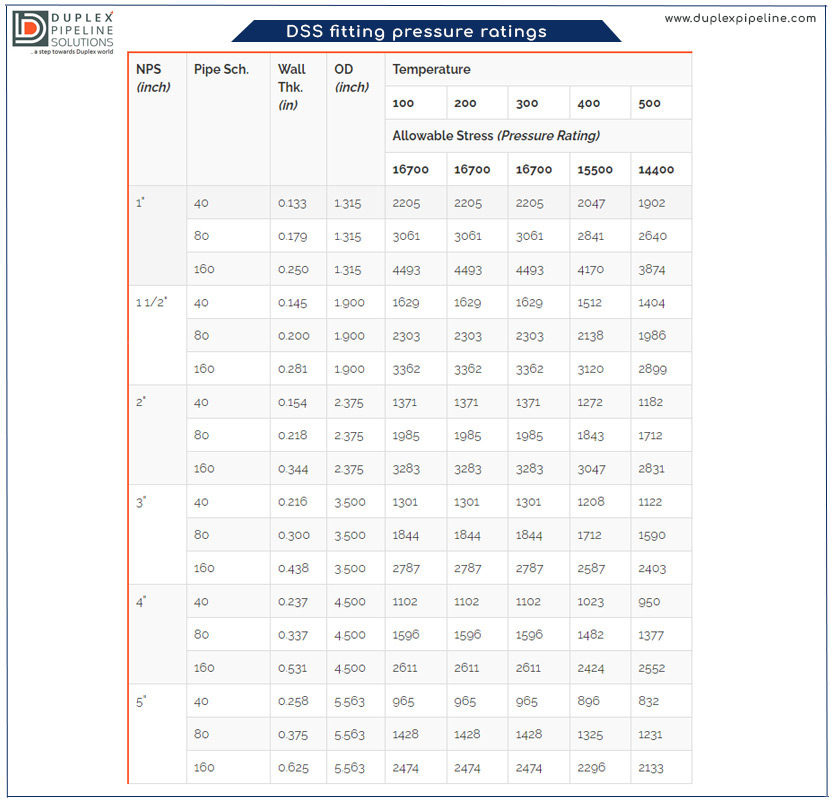
If your piping system runs in high-pressure, corrosive, or critical service conditions, standard-grade fittings and pipes may not hold up long-term. Super duplex stainless steel, a higher alloy version of duplex, exhibits exceptional strength, so fittings made from it can sturdily withstand high-pressure conditions without failure or deformation. These fittings also excellently resist localized corrosion phenomena such as pitting and crevice corrosion, ensuring the pipe fitt components last reliably for years across all kinds of difficult conditions.
How Are Super Duplex Fittings and Pipes Manufactured?
Manufacturers use well-known casting procedures for producing SDSS fittings, particularly the more intricate and tricky designs. Forging is another popular method, shaping different pipe fittings by applying compressive forces to the pipe material. Machining processes such as turning and drilling refine the shape and dimensions of SDSS bend fittings, and every batch undergoes heat treatment to enhance mechanical properties.
Types of Fittings and Pipes: Elbow Pipe, Couplings & Caps
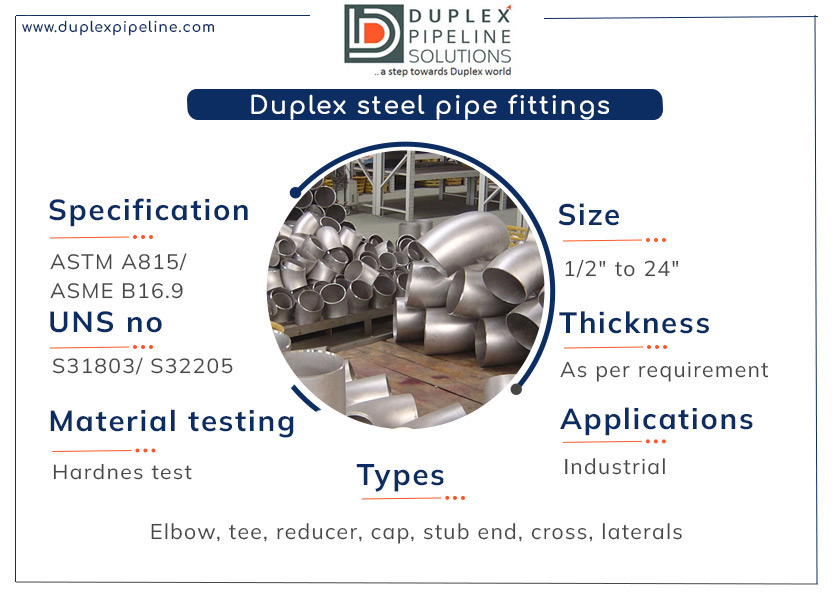
This category of duplex components comes in several standard configurations:
- Elbow pipe – changes the direction of flow within a piping system
- Tee – a T-shaped fitting allowing fluid to branch off in different directions
- Pipe couplings – join two lengths of pipe and elbow sections together
- Reducer – connects pipe with elbow or straight sections of different sizes
- Fitting caps – close off the end of a pipe run
Specifications of Super Duplex Components
Duplex Pipeline Solutions manufactures these components to the following specifications:
- Yield strength: approximately 415 MPa
- Tensile strength: 60–95 Ksi
- Types: elbow, tee, reducer, cap
- Schedule: SCH5 – SCH XXS
- Method: seamless, welded, or buttweld
- Size: 1/2″ – 48″
- Coating: 3LPE, Epoxy
- Testing: NDT (non-destructive testing)
- Application: oil and gas, power generation
Chemical Composition & Corrosion Resistance
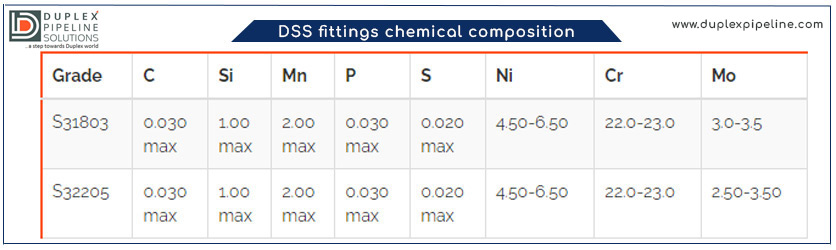
The alloying elements in SDSS fittings directly affect their performance across different environments. Chromium, the primary alloying element, provides excellent corrosion resistance. Nickel enhances strength and toughness, while molybdenum increases resistance to localized corrosion such as pitting and crevice corrosion — the combination is what allows super duplex fittings to consistently outperform standard austenitic stainless steel fittings in aggressive service.
Common Sizes: NPS Range for Super Duplex Buttweld Fittings
Standard sizes typically fall within the following nominal pipe size (NPS) ranges:
- DN 15 to 300 – common for smaller-diameter piping systems, prevalent in oil and gas
- DN 350 to 600 – ideal for medium pipe systems requiring higher flow rates
Hardness & Long-Term Durability
Super duplex stainless steel typically exhibits higher hardness than standard austenitic stainless steel, due to its increased alloying content and dual ferrite-austenite phase structure. Hardness is often measured using the Rockwell or Brinell scale, with values for stub ends typically ranging between 25 and 40.
Price vs Performance: Is Super Duplex Worth the Premium?
Super duplex components are usually more expensive because of their higher alloying content and the added complexity of manufacturing. But despite the higher price point, super duplex delivers excellent corrosion resistance compared with standard austenitic stainless steel or other grades, along with exceptional mechanical strength making it the more reliable choice for critical applications where durability can’t be compromised.
Why Choose Duplex Pipeline Solutions
- High-quality manufacturer of super duplex fittings and pipes in India
- Full chemical composition and mechanical property documentation on request
- Custom sizes, schedules, and coatings available